

On the UN Security Council meeting, a new wave of Russian shelling of civilian infrastructure and attacks on Black Sea ports was condemned. Diplomats emphasized the increase in civilian casualties and the threat to food security.
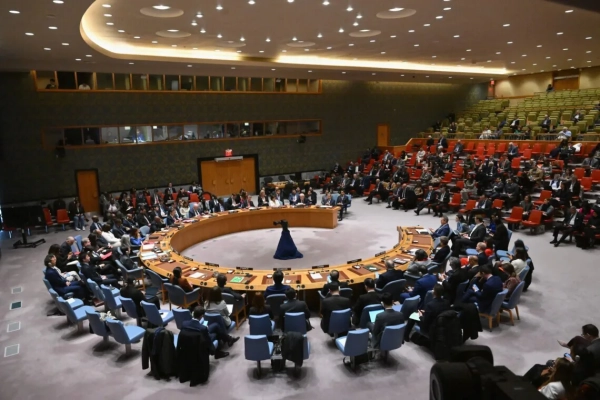
At a special meeting of the UN Security Council, convened at the initiative of official Kyiv on Monday, July 27, diplomats and representatives of the organization’s Secretariat strongly condemned the new wave of Russian shelling of Ukraine’s civilian infrastructure, systematic attacks on Black Sea ports and civilian vessels, as well as strikes on diplomatic missions.
UNN has compiled the main statements made.
Massive attacks on cities and an increase in civilian casualties
The UN Security Council meeting began with a detailed report from the head of the UN Department of Political Affairs, Kayoko Gotoh. She emphasized the catastrophic increase in civilian casualties in Ukraine as a result of massive Russian strikes using missiles and drones.
Since our last Security Council meeting on July 9, more than 170 civilians have been killed and 1028 injured across Ukraine as a result of the Russian Federation’s air attacks. Residential buildings, kindergartens, supermarkets, and logistics warehouses have been hit. In July alone, at least 56 civilians were killed and 232 injured in Kyiv.
– she stated.
Kayoko Gotoh added that the UN Office of the High Commissioner for Human Rights has recorded at least over 16,000 deaths and over 90,000 injuries since the beginning of the full-scale invasion.
She also stressed that international humanitarian law strictly prohibits any attacks on civilians and vital infrastructure.
These attacks are unacceptable and must stop. The United Nations condemns such attacks wherever they occur.
– Gotoh summarized.
Attack on the Latvian Consulate in Sloviansk and attacks on diplomatic missions
A targeted Russian strike with guided aerial bombs (KABs) on Sloviansk, which destroyed the building of the former honorary consulate of Latvia, as well as attacks on warehouses of international humanitarian organizations, became a separate critical issue of the meeting.
Latvia’s representative to the UN, Sanita Pavlut-Deslandes, made a statement condemning the aggressor’s actions and emphasizing the resilience of the Ukrainian people.
In turn, Denmark’s representative, Christina Markus Lassen, also noted Russia’s destruction of diplomatic and humanitarian facilities during her speech.
We know that the premises of the Latvian consulate were damaged as a result of the strikes on Sloviansk. We express our solidarity with both Latvia and, of course, Ukraine. Premises used by UN programs and warehouses of international organizations in Kyiv were also hit. In these cases, without exception, there are no grounds for striking civilian objects in densely populated areas. Such acts are a flagrant violation of international humanitarian law. All perpetrators must be brought to justice.
– the diplomat stated.
Food terror: shelling of ports, civilian vessels, and warehouses
UN representatives and diplomats paid special attention to Russia’s deliberate destruction of Ukraine’s port and agricultural infrastructure on the Black Sea and Danube, which led to a 20% increase in global food prices.
It is reminded that over several days, the ports of Odesa, Chornomorsk, Izmail, and Mykolaiv, as well as civilian ships under the flags of Guinea-Bissau and the Republic of Togo with crews from Syria and India, came under fire from the Russian Armed Forces. In addition, the enemy is destroying agricultural fields and warehouses of the World Food Programme (WFP).
The consequences of Russian aggression extend far beyond Ukraine. Russia’s deliberate attacks are hitting global food security… On July 17, a World Food Programme warehouse was hit four times in one day. This is not a coincidence: the World Food Programme has registered over 18 such attacks.
– the Latvian representative emphasized.
The representative of France, in turn, confirmed that Russia’s actions pose a threat of hunger in the poorest regions of the planet:
“Moscow continues and even increases its policy of massive aerial attacks, striking indiscriminately at civilian areas with drones and ballistic missiles… As a result of strikes on the infrastructure of Black Sea ports and civilian vessels, not only civilians are killed, but also the food security of millions of people is threatened,” the French diplomat noted.
Nuclear threat around Zaporizhzhia NPP and humanitarian response
The acting Deputy Secretary-General for Humanitarian Affairs, Indrika Ratwatte, drew attention to the critical state of the Zaporizhzhia Nuclear Power Plant, which has completely lost external power supply 10 times in the last three months due to shelling, as well as to the development of a winter aid plan for Ukraine.
After this, the participants of the meeting called on Ukraine and Russia for an immediate, unconditional ceasefire and the restoration of peace in accordance with the UN Charter and international law.
In particular, this was done by the Deputy US Permanent Representative to the UN, Dan Negrea.
There is no military solution to this war. Both Ukraine and Russia must return to the negotiating table. Too much blood has been shed. The world is paying too high a price for this war. It must end. The United States remains ready to play a constructive role in achieving this outcome and facilitating negotiations between Moscow and Kyiv. Our commitment to peace in Ukraine is unwavering.
– Negrea emphasized.
How Russia responded to the accusations of the Ukrainian side
The position of the Russian Federation at the Security Council meeting was presented by the acting Permanent Representative of Russia to the UN, Anna Evstigneeva.
The diplomat began with reciprocal accusations. According to her, Ukrainian military allegedly:
- struck with drones in the Bryansk region of the Russian Federation at a bus carrying children from Belarus;
- attacked a residential building in the city of Kerch (annexed by Russia in 2014), where children were injured;
- in Rostov-on-Don, attacked a center for homeless people;
- hit a children’s recreation center;
- directed strike UAVs at an ambulance in Horlivka (territory of Donetsk region occupied by the Russian Armed Forces), etc.
In turn, responding to the accusations of the Ukrainian side, Evstigneeva used propaganda clichés. According to her, the Russian military does not strike civilian buildings in Ukrainian cities. They allegedly attack military-industrial complex enterprises, which the Ukrainian authorities deliberately place in densely populated areas of cities and use civilians as cover.
Similarly, the acting Permanent Representative of the Russian Federation to the UN tried to justify the strike by the Russian Armed Forces on Kyiv region, where a weapons exhibition was held. In addition, Evstigneeva “explained” the reasons for the drone and missile attacks by Russians on terminals and branches of “Nova Poshta.” According to her version, the Ukrainian postal operator helps “deliver dual-use goods” and therefore became a “legitimate target” for the Russian military.
Finally, the Russian diplomat once again spoke about forced mobilization in Ukraine and used the incident in Lviv to illustrate her point: in the Sykhiv district in early July, a group of civilians attacked military enlistment office representatives. Evstigneeva called the riots a “desperate step” and a “lynch court” and concluded her speech by stating that the Kremlin does not intend to stop hostilities against Ukraine and will continue to “achieve the goals of the SMO.”
The representative of Great Britain to the UN Security Council reacted sharply to this. She said that Russia is trying to equate its massive strikes on Ukrainian cities, occupation of territories, and Ukraine’s actions to defend itself from aggression.
Russia seeks to draw a parallel between its continuous bombings of Ukrainian cities, the illegal and brutal occupation of Ukrainian territory, and Ukraine’s efforts at self-defense. But there is no equivalence. Russia’s invasion is a violation of international law.
– the diplomat concluded the discussion.
Context
On July 20, 2026, Ukraine submitted a request for an emergency UN Security Council meeting in connection with Russian shelling of civilian vessels in the Black Sea.
It was supported by France, Great Britain, Denmark, Greece, and Latvia.
According to the acting head of the Ministry of Foreign Affairs of Ukraine, Andrii Sybiga, the reason for this demand was the situation when the Russian military attacked at least three civilian ships in Black Sea ports. Dozens of crew members were killed and injured then.
“Today, not a single ship has passed through the Ukrainian maritime corridor in the Black Sea – right in the middle of the harvest season. This is deliberate economic and humanitarian terror. Millions of families in Africa, Asia, the Middle East, and Latin America may face rising prices and hunger if this terror continues,” the acting head of the relevant ministry wrote on his X page on July 22.
On the same day, it became known that the Russian army hit the bulker Golden Rose in the Black Sea with a drone. Ukrainian military personnel were forced to rescue the crew members. Thanks to their coordination and prompt response, 16 men avoided serious injuries and death. All of them are citizens of other countries.
A few days earlier – on July 19 – the Russian Armed Forces attacked a vessel flying the flag of Guinea-Bissau. Victims could not be avoided; six crew members died, and two men were injured.
In addition, on July 13, the Russians hit a merchant ship flying the flag of the Republic of Togo. As a result, three people died, and five were injured.
Recall
Somewhat earlier, in June 2026, Ukraine convened the UN Security Council due to the Russian Federation’s attacks on cities and the Kyiv-Pechersk Lavra.