

Only 43% of infants receive exclusive breastfeeding up to 6 months. WHO recommends breastfeeding to protect health, and donor milk banks help premature babies.
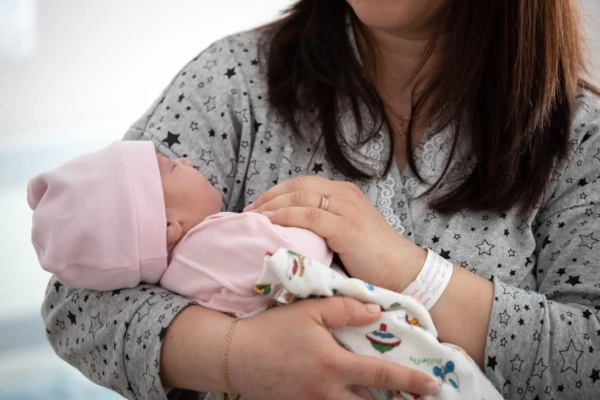
Only 43% of infants are exclusively breastfed in the first half of their lives. Meanwhile, breast milk not only provides infants with nutritious components but also builds the protection necessary for the baby’s healthy growth. For World Breastfeeding Week, we explain its impact on a child’s health.
Skin-to-Skin Contact
Immediately after birth, if the mother’s and child’s condition permit, continuous skin-to-skin contact is recommended for at least the first hour of life, or longer – as long as the woman desires. Ideally, such contact should last until the first breastfeed (first latch).
As indicated by the Public Health Center, such contact helps the newborn adapt more easily to the new environment, maintain body temperature, breathe more steadily, and independently find the breast for the first feed. For the mother, it facilitates the successful initiation of breastfeeding, milk production, and the formation of an emotional bond with the child.
The “Golden Hour” – Recommended Start to Breastfeeding
The first hour after birth is often called the “golden hour.” It is during this time that the World Health Organization recommends initiating breastfeeding.
Early latching helps the baby receive colostrum, promotes lactation establishment, and is associated with a reduced risk of diseases and mortality among newborns.
Colostrum – The First Natural Defense
In the first few days after childbirth, the mammary glands produce thick colostrum, which the baby receives after birth. It is produced in small quantities, but this is exactly the amount a newborn needs in the first days of life.
Colostrum contains a high concentration of antibodies and other protective components that help the baby’s body fight infections, support immune system development, and adapt to the new environment. This is why it is often called the baby’s first natural defense.
The First Six Months – Breast Milk Only
WHO and UNICEF recommend exclusive breastfeeding for the first six months of life. This means that all the baby’s nutritional needs are met solely by breast milk – without water, tea, juices, or other products (except for medications, if prescribed by a doctor).
Experts recommend continuing breastfeeding after six months as well.
Lifelong Benefits
Scientific research indicates that breastfeeding helps reduce the risk of diarrhea, respiratory infections, and other common childhood illnesses.
In the long term, breastfeeding is associated with a reduced risk of developing overweight and obesity, type 2 diabetes mellitus, and may positively influence a child’s cognitive development.
What to Do If Breast Milk is Absent or Insufficient?
Breast milk is the primary source of nutrition for infants. But what if milk is absent or insufficient? For such cases, there is the practice of donor breast milk, which is becoming more widespread in Ukraine. It often acts as spontaneous assistance from one mother to another, but increasingly it is taking regulated forms through so-called breast milk banks. One such bank operates in the capital at the Perinatal Center.
The primary goal of the bank is to provide donor breast milk for: prematurely born infants; newborns with critically low body weight; healthy, full-term infants whose mothers are temporarily unable to breastfeed due to medical reasons.
Donor milk is especially important for premature infants.
The digestive system in premature infants is immature, so they tolerate artificial feeding much worse compared to breast milk. Such newborns still have underdeveloped intestinal enzyme systems, protective mucous barrier, and immune mechanisms. Because of this, formulas can increase the risk of serious gastrointestinal complications. The most dangerous of these is necrotizing enterocolitis – a severe condition characterized by inflammation and damage to the intestinal wall
– explained Anna Osipova, head of the breast milk bank at the capital’s Perinatal Center, pediatrician-neonatologist.
The use of donor breast milk, besides reducing the development of necrotizing enterocolitis, allows for improved tolerance of enteral nutrition; faster achievement of full feeding volumes; reduced frequency of infectious complications; and shorter stays in the intensive care unit for some infants.
Therefore, it can be confidently stated that the establishment of the Breast Milk Bank in Kyiv has made it possible to apply a feeding method whose effectiveness has already been proven by global practice
– emphasized Osipova.
Donor milk is provided free of charge to infants who have indications. Monthly, the Bank assists in feeding up to 80 infants.
The quality of milk at the Bank is meticulously monitored: each batch undergoes bacteriological culture. If it does not meet standards, the batch is disposed of.
We also analyze each batch of milk for the content of fats, proteins, and carbohydrates, as well as calories. The composition determines which department the milk will go to
– explains the head of the Milk Bank.
Milk reaches the young patients only after laboratory control and mandatory processing. All donor milk is pasteurized. Donors also undergo examinations.